



































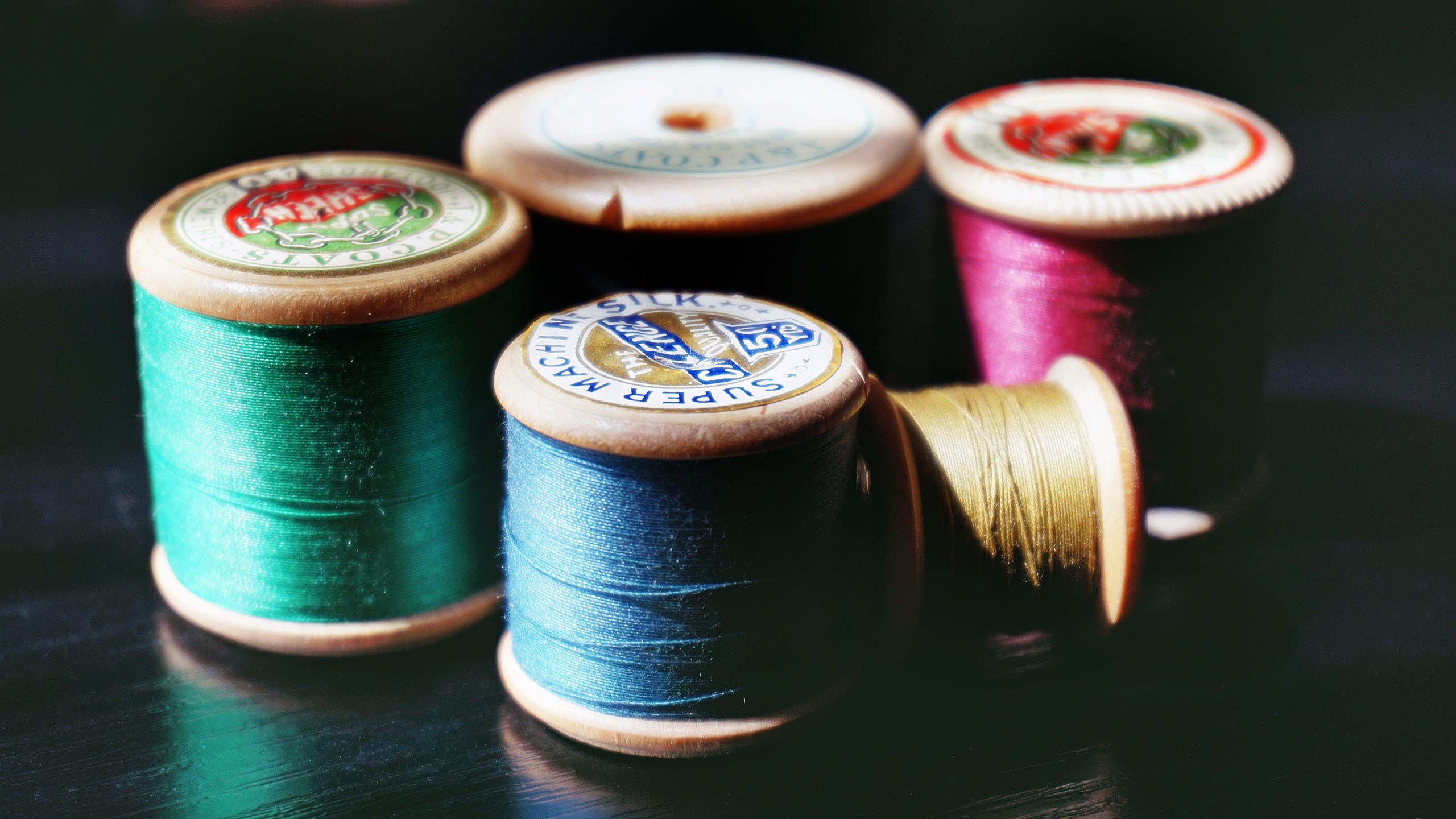
One of the smallest parts used in garment manufacturing is sewing thread. However, the efficiency of its work can make the difference in the condition, look, resistance, and also quality of a garment. Tenacity is one of the most significant properties to measure the strength of sewing thread.
When manufacturers are picking threads for items that are likely to be washed often, stretched, abraded, pulled, and worn, thread tenacity is also a key consideration. Tensile strength seems to be the most common term used to reflect breaking strength, and tenacity is a better measure to compare different-sized threads.
The knowledge of the tenacity of sewing threads will be useful to the apparel manufacturers to select appropriate sewing threads, limit thread being broken in seams, minimize production problems, and enhance the quality of the finished garments.
Table of Contents
What Is Thread Tenacity?
Thread tenacity is the strength of a thread, measured against the linear density of the thread or the mass per unit length of the thread. Basically, it informs what amount of force it takes to stretch a thread to its breaking point compared to the thickness or weight of the thread.
This is relevant because a single force measurement of the breaking strength of two threads may not be a good comparison. Generally, a thicker thread will be able to carry a greater load than a thinner one. Tenacity is a normalized measurement enabling manufacturers and textile professionals to compare the natural strength efficiency of various textiles.
Generally, higher tenacity means thread with a higher resistance per unit linear density.
Tenacity vs. Tensile Strength
It is important to note the distinction between tenacity and tensile strength. There is a relationship: they are not the same.
The term “tensile strength,” in general parlance, means the amount of force a thread can withstand before failing. Usually expressed in units of newtons or centinewtons.
Tenacity is, on the contrary, a measure of the tensile strength per unit length of the thread.
This can be useful when comparing the size of different threads. For instance, the breaking force of a heavy thread can be larger just because it has more material. A thinner thread might have a higher tenacity; that is, it could be stronger for its weight.
Both can be helpful to apparel manufacturers. Breaking strength is used to assess the ability of the thread to carry its load, and tenacity to compare the strength efficiency of various thread constructions.
Why Is Thread Tenacity Important in Apparel Manufacturing?
There are a host of forces that a seam on a garment must endure throughout its use. Seams might be subjected to mechanical stresses when a person is putting on a shirt, bending a pair of trousers, stretching sportswear, or washing a garment.
The sewing thread may be too weak for the application and will eventually fail.
Therefore, there is a special importance to examining the thread tenacity when manufacturers are considering:
- Seam strength requirements
- Heavy-duty garments
- Workwear and uniforms
- Sportswear and activewear
- Denim and heavyweight fabrics
- Protective clothing
- High-stress seam areas
- Garments exposed to frequent washing
But the high tenacity does not guarantee that a thread will be able to be used for all clothing. The factors affecting the seam performance are type of stitch, stitch density, construction of fabrics, size of threads, kind of needles used, and conditions of sewing.
Factors That Affect Thread Tenacity
The strength of a sewing thread is influenced by a variety of qualities of the fiber and the way the thread is wound.
1. Fiber Type
The mechanical properties of fibers vary according to their types. Polyester (recycled polyester thread), nylon, cotton, and other fibers may perform differently in terms of strength and elongation.
Polyester fibres (polyester corespun thread) are much used in the clothing industry, as they can provide a useful balance of strength, durability, dimensional stability, and resistance to many environmental effects.
The exact grade and type of fiber is also a factor, and so it is not solely by knowing the fiber type that you can assume performance will be.
2. Thread Construction
The construction of the threads can have a significant effect on the strength of the thread.
For spun threads, one uses only staple fibers, whereas for filament threads, one uses continuous filaments. Core-spun threads are features with an outer covering and a core, typically from a strong filament.
Each construction has different characteristics. For example:
- Spun threads can give you a soft surface and right flexibility.
- A smooth surface and high strength can be provided by the filament threads.
- Core spun threads may be a core with the fiber qualities of the covering material.
3. Twist
Twist plays an important role in thread construction. It aids the holding of fibers together and affects the strength, flexibility, and appearance of the thread.
Excessive amounts of twist may affect performance. The recommended twist is dependent on the thread individual, the method, and the purpose.
4. Thread Size
Thread size and tenacity should not be confused.
A particular thread may have a higher linear density and total breaking strength but lower tenacity. So, it is important for manufacturers to take into account the size and the tenacity of the thread when choosing which one to use.
5. Tenacity and Seam Performance
High thread does not necessarily mean a strong seam.
Final seam strength depends upon the interaction of the thread and the fabrics and their stitching. The very strong thread and very weak fabric may be torn before the thread breaks.
Likewise, if the stitch density is wrong, it may allow the thread to cause too many perforations in the fabric, even when using a strong thread.
There are other factors that affect the performance of the seam:
- Stitch type
- Stitch density
- Thread size
- Fabric thickness
- Needle size
- Sewing tension
- Seam construction
- Thread elongation
- Fabric strength
This is one reason that manufacturers should test threads for performance in the total sewing system.
How High-Tenacity Threads Benefit Manufacturers
There are a number of practical advantages to using a suitable thread that is high in tenacity.
For one, it will enable the manufacturers to reach the target seam strength without expanding the thread sizes. This can be very handy where a manufacturer wishes to have good seams and have a nice clean look.
Second, high-strength thread can lower failure rate at seams where high loads are encountered. Seams are used in workwear, uniforms, outdoors, and sportswear and can cause stress in any of those applications.
When it is used correctly, high-tenacity thread can also help increase production efficiency. A reduction in the number of thread breaks can lead to reduced machine downtime and operator assistance.
But it doesn’t always mean that you can solve every sewing problem by choosing a stronger thread. Even when tension or needles are correct and thread is good and the machine is set properly, failure can result.
Tenacity in Different Apparel Applications
Different garments have different sewing requirements.
For lightweight shirts and fashion articles, it may not be the first thing to consider that they must have extremely high tenacity. The features of smooth finish, flexibility, fine thread, and low seam bulk may be more essential.
Denim, workwear, and uniforms in general will typically require higher seam durability. Stronger thread constructions that are suitable for repeated mechanical stress could be useful in these applications.
Sportswear poses another difficulty since the garment could stretch a number of times as the athlete moves. In this instance, it is necessary for manufacturers to consider strength as well as elongation and not only tenacity.
The need for protective clothing may be even more stringent. The thread should be able to resist some degree of abrasion, high temperatures, chemicals, moisture, and repeated laundering depending upon application.
How Is Thread Tenacity Tested?
The method to determine thread tenacity is generally through tensile test equipment. The specimen of thread is clamped between the clamps, and a constant stress is applied till it breaks.
The test gives the information about the breaking force of the thread; tenacity is calculated on the basis of the linear density of a thread.
Due to the variability of textile materials, testing can be done in controlled atmospheric conditions.
Manufacturers should also be aware that thread strength in the laboratory does not always relate to the strength of a finished seam. These value-added production trials and seam tests complement laboratory measurements.
Common Misunderstandings About Thread Tenacity
One belief, as is common, is that the greater the tenacity, the better the thread. In practice there are a variety of properties to consider when choosing a thread.
Another error made is that the strengths of threads are equal to the strengths of seams. Seam is a system of threads, fabrics, types of stitches, and sewing parameters.
Manufacturers also fail to consider the size of the thread sometimes. A strong thread is not necessarily a large thread, and if it is too large, you will end up getting chubby seams. Look at the garment, and you will need to adjust the needle and machine setting.
The dress code should, therefore, be the selection of a suitable tenacity of thread for the particular use and not the strongest available product.
Conclusion
Tenacity is a significant measure of the strength efficiency of apparel sewing threads. It gives manufacturers a handy reference for comparing the strength of a thread based on the linear density, and it can help with choice when it comes to choosing threads for specific garment uses.
Yet it’s important to remember that tenacity itself is not a factor to consider. Overall seam performance depends on the type of fiber, construction of the threads, twist, thread size, elongation, type of stitch, strength of a fabric, choice of the needle, and sewing conditions.
Technical specifications with sewing and testing with seams produce the best result. Apparel manufacturers can make better choices of thread by more fully understanding the characteristics of it and its interactions with other elements of the sewing system to minimize seam failure and enhance production efficiencies and to create garments that deliver performance during their prescribed service life.


